Showing posts with label dinner. Show all posts

Monday, July 21, 2008

beautiful on the inside

Mmmmm mmmmm - open wide for a mouthful of mud and snow covered in little white worms! Or at least, that is what my lovely pie has ended up looking like in this picture. It's not the most glamourous of gastronomical spoonfuls, in any sense.


But to hell with glamour. As the newscasters shower us with ever more scary statistics and shadowy harbingers of impending economic doom, and the frequency with which we converse about energy bills and the price of a loaf of bread multiplies exponentially, there is a place for a little humble pie. Simple - yes, ugly - maybe so. But tasty, comforting, cheap and easy too...


I've told you before of my love for lentils, I'm sure. And may have even mentioned how smitten I am with sweet spring cabbage... So, whilst for most people the idea of the two together may engender merely mild disgust, or even sniggers at the supposed flatulent effects of these two fibrous heavyweights, I am licking my lips with glee.
This is then, a fairly basic little recipe. It's nothing particularly new or clever, but with a little seasoning trickery and some rich luxurious dairy products sneaked in, it's really much more delicious and satisfying than you might imagine of a lentil and cabbage pie...
Saucepan-Style Vegetarian Shepherd's Pie
(Serves about 4)
* Chop an onion, a couple of sticks of celery and a carrot in to small dice
* In a heavy over-proof cocotte (if you have one - otherwise use a normal saucepan and transfer to oven dish later) heat a little olive oil over a low flame, and cook the diced veg, stirring frequently until softened
* Add in half a cup of lentilles vertes, a couple of bay leafs, a finely chopped clove (or two) of garlic, and stir until the lentils are coated in oil.
* Add a good squirt of tomato puree and mix in
* Top up with a couple of cups of stock, bring to the boil and lower to a simmer (stir every couple of minutes and top up with water/stock if it looks like getting dry)
* Meanwhile, cube about 6-8 small potatoes (3-4 larger ones), peeled if you like (though I rarely bother) and cook in salted boiling water.
* After about 15-20 minutes, your potatoes should be done, and your lentils will just want another 10 minutes or so. At this point, drain the potatoes and add half a pointed (spring) cabbage, finely shredded, to the vegetable pot. Add also a can of chopped tomatoes.
* Mash potatoes with a generous knob of butter and a splash of cream (or milk if you don't have cream) and maybe a little parmesan, or any other hard cheese of your choosing.
* Once the lentils are almost cooked, and the cabbage wilted down, mix around, adjust seasoning for taste, and then top with the mashed potato (transfer first to an overproof dish if your saucepan isn't ovenproof)
* Pop in an oven preheated to 200C and cook for 20-30 minutes until browned on top.
* Serve.

Saturday, June 07, 2008

Squash and walnut risotto

Just a note on a new favourite risotto combination:

Sweetly squashy sweet squash
Tart chewy sundried tomatoes, wrinkled lipstick red
Crunchy little brain-like walnuts
Thyme, just a few leaves like light snow in spring
And parmesan, of course, dear parmesan.

Mmmmmmmmm mmmmmm

(ps - for risotto instructions and quantities see this post - cut out the lemon and fennel, and add the tomatoes near the start of cooking, the squash and walnuts right at the end. Squash should have been roasted in a medium-hot oven in olive oil for about 30-40 mins until soft and brown-edged. Walnuts - just break them up a little and chuck them in. )

Update - In response to a request I am amending my lazy ways, and putting a whole recipe here!

Skin a butternut squash and cut into chunky dice (about 1" across). Coat in oil and roast in a preheated medium-hot oven until soft (about 30-40 mins)
Meanwhile, fry off a finely diced onion in a generous slug of olive oil over a low heat.
Once soft, add a handful of chopped sundried tomatoes and about 400g/14oz arborio rice, and stir until all the rice is coated with oil.
Tip in a small glass of white wine and stir in.
Cover with a generous amount of vegetable stock, bring to a simmer and put the lid on. Stir every 5 minutes or so for the next 30-40 minutes, making sure the rice doesn't stick to the bottom, and adding more stock or hot water as required by the rice (I never bother with the one spoon at a time method - it's ever so time-consuming and I'm not sure it makes that much difference - do try not to forget your risotto tho - it will burn!)
When the rice is cooked to your taste, stir in a little butter and parmesan for extra creaminess (optional), then add the squash and a couple of handfuls of chopped walnuts, stir lightly to mix through
Serve scattered with chopped thyme and parmesan shavings

Wednesday, May 14, 2008

Simple things

My mother told us once how one of the most memorable meals she had consisted of a boiled potato, a boiled carrot and a boiled onion. There was possibly another vegetable, maybe even some white sauce, but that was the gist of it. Each thing just tasted of itself and that was perfect and exciting just how it was.

Of course, we mocked. A boiled onion! A boiled potato! But, oh, how I know now - sometimes a simple boiled potato - smooth, fresh, nutty - can be truly a thing of beauty.


Recently this is the kind of thing I've been hankering for in the evenings. No complicated melange of unusual items and techniques and flavourings, just a few unadulterated lovely ingredients.


How can you go wrong with some good parma ham and a plate of ripe melon?


And the other day I delighted myself by using the leaves off the beetroots that would often I suppose get thrown away. Certainly I've never cooked with them before. Wilted quickly in a little butter and served on toasted home made bread with a squeeze of lemon juice and a poached egg, they made a really enjoyable supper. It's so much more satisfying to make something easy and pleasing out of some odds and ends hanging around than to spend too much time and money to churn out something slightly disappointing.

And then, we had the meal at the top of this post recently, which finally gives me some kind of recipe to post. With asparagus starting to appear all over the place my mind drifted to homemade mayonnaise. I'd made it once before in an electric food mixer, and really wasn't that impressed, but I had a little time to kill and thought I'd give it another go.

So, I'd like to report that if, like me, you thought you needed a mixer to make mayonnaise, you can consider yourself corrected - a wooden spoon and plenty of elbow grease is all it takes.

And it's good. Very very rich, but a plate of fresh olive oil and lemon juice dressed asparagus, those lovely boiled potatoes and a dollop of silky, sharp mayonnaise is really quite, simply, superb.

Homemade mayonnaise
  1. Beat one egg yolk and a pinch of salt in a bowl with a wooden spoon
  2. Add 75ml oil (olive or half olive and sunflower as I used to make it less strong flavoured) DROP by DROP, beating all the time. The mixture will get very thick.
  3. Beat in a squeeze of lemon juice
  4. Add another 75ml oil - this time you don't need to be quite as careful but still pour in little bits. Alternate the oil with small quantities of white wine vinegar (about a dessertspoon in total).
  5. Season to taste with salt and pepper.


Friday, March 14, 2008

Lentils. Fish. Salsa

That's right, today I am extolling the virtues of 1. eschewing carbs in favour of pulses 2. matching paw paw with fish. Excellente.

So, first, lentils - my humble little friends. This dish features probably my favourite lentil - the lentille verte. Like puy, but cheaper (I know this might be considered philistine in some circles but I'm not really sure I get the point of puy lentils. They just taste the same as lentilles vertes to me, for twice the price, but there we go). I don't see how you could fail to be charmed by these mini green pebbles of goodness. They are full of an earthy, satisfying flavour. And easy to cook to boot.

Now, let's introduce our fish of the day. Chosen mainly because for value for money reasons, he's the exotically named tilapia. A good choice it turned out - sweet white flesh, nice and firm.

And finally, salsa! I love the sweetness of pawpaw and the zing of lime - fresh and sweet and spicy and how nice to have all that colour on the plate - orange and red and purple and green....

Put it all together and you have a really good light dinner dish. I really think with lentils and fish you don't need any extra rice or potato or bread or whatever - this was plenty for us.

Tilapia Fillets with Pawpaw Salsa and Lentille Vertes
(serves 2)

Put 1/2 cup of lentilles vertes in a pan with a cup of water. Bring to the boil, cover and simmer for about 20-30 minutes until soft but still with a touch of bite. Season with salt and pepper to taste (add a bayleaf too if you have one). Top up with water as needed, and give an occasional stir to stop any sticking to the pan.
Meanwhile, make your salsa. Seed and dice one pawpaw and about 6 ripe cherry tomatoes. Finely slice 1/4 red onion, and some fennel stalks, if you happen to have a fennel lying around (nice but non-essential).

Put these all in a bowl together, and add a handful of chopped coriander (cilantro), a finely chopped fresh red chilli, the juice of two limes, and a pinch of salt and pepper. Stir to mix.

When your lentils are just about ready dust a plate with some flour, salt and pepper, and coat two Tilapia filets on both sides. Heat a little olive oil in a frying pan until hot to hold your hand over it.

Cook the fish on both sides for a few minutes until nicely golden brown, firm to the touch, and flaking cleanly when inserted with a fork.

Serve with extra lime

Monday, March 03, 2008

Pink Scallops

You know when you really love something and you can't help but share your enthusiasm and you recommend it to all your friends and acquaintances, but then it turns out all wrong, and you sit there feeling slightly cheated, protesting, "but it wasn't like this before"? A good restaurant, a cool bar, a show, a dish...

Well, happily that didn't happen when I sung the praises of scallops to a visiting friend. She had only tried them once before - barbecued - and found them unremarkable.

And they can be unremarkable, but they can also be sublime. These were big fat specimens. We cooked them in a hot pan, dusted on both sides with a little sugar, salt and pepper til they were brown on the edges, then perched them atop a simple combination of finely sliced fennel, segments of pink grapefruit and diced avocado.

They were sweet and soft and perfect with the tang of the grapefruit. In fact, I would happily have pared it down further and just had a plate of slightly caramelised scallops on pink grapefruit segments, but Shelley thought the crunch of the fennel was a worthwhile addition.

Either way, a good dish and supremely satisfying to be able to share the true beauty of these seafood pearls and convert someone to the love of scallops! Once again, I feel slightly inadequate for giving you a combination rather than a real recipe - but well, it's a good combination, and you know I'm all about the easy stuff.


Caramelised Scallops with Pink Grapefruit Salad.
(serves 2)
  1. Thinly slice half a bulb of fennel and dice a ripe avocado.
  2. Place in a bowl over which you will segment one pink grapefruit, letting the juice drip in to the bowl.
  3. Dust 4 fat or 6 smaller scallops with sugar, salt and pepper and heat a dry pan until pretty hot.
  4. Cook for a couple of minutes on each side until the flesh has turned opaque and the surfaces caramel brown.
  5. Place scallops on salad. Et voila.

PS - I don't know what is going on with all the links falling to the bottom of the page! I will try and look into that.

Tuesday, February 19, 2008

A little bit of this, a little bit of that

I've been watching Masterchef recently. Apart from being great 'roll your eyes at the telly TV' (for the ludicrous amateur dramatics of judges John Torode and Greg Wallace as they make 'tough' decisions, cast their judgmental eyes over the contestants' work and raise eyebrows in a serious manner) there's also been some pretty good cooking. One of the contestants in particular - Emily - made some dishes that were genuinely surprising and really exciting.


Which has been making me and my meals feel disappointingly pedestrian. 'Why can't I think up crazy rabbit, langoustine and pear dishes, or work out how to make beetroot into tagliatelle?!', I fret. When I am planning dinner in my head, it's different variations on old combinations that I work with, bits of this, bits of that. Like a comfortable old wardrobe where everything matches. A bit like my wardrobe, come to think of it. My 'innovative' combinations, both sartorial and culinary, are rarely successes...


Still, we can not all creative culinary geniuses be, and sometimes it's better to stick with the pieces you know...


Which is bringing me around to this dish above. The bulghur wheat from my Fabulous Crunchy Salad is making a come back; roasted aubergines and crispy onions I loved recently in a dahl recipe from the Hungry Tiger; the pinenuts and sultanas something I've come across in the Moro books I've been flicking through recently.


It's good - a kind of rich, fruity and yet wholesome-tasting comfort dish.

I served it with a yoghurt slaw - finely shredded green veg (white cabbage, cucumber, green pepper and green chillies) with lemon juice, salt, pepper and natural yogurt.


Jewelled Bulghur Wheat
(serves 2)

  • Chop half an aubergine, half a courgette and half a red pepper into about 1 cm square dice, and toss in a little olive oil, salt and pepper. Spread out on a baking tray and bake in a hot oven for about 30 minutes until crispy and soft in the middle.

  • Meanwhile, bring to the boil and simmer 1/2 cup bulghur wheat (the coarse type) in 1 cup of water for about 15 minutes until soft and fluffy (or follow instructions on the packet) and set aside to cool.

  • Mix a handful of golden sultanas in whilst cooking so they can plump up nicely.

  • Toast a handful of pinenuts in a dry pan over a medium heat, shaking the pan regularly until they are just browned. Set aside

  • Chop a small bunch of fresh mint.

  • Finally, fry some very thinly sliced onion in hot oil, moving continuously until crispy and brown. Put on a piece of kitchen towel to drain off some of the oil.

  • Mix the roasted veg and mint through the wheat, serve in bowls or plates, and top with pine nuts and crispy onions

Thursday, January 24, 2008

Steak for vegetarians


The photo yet again doesn't do this dish justice, so ignore that slightly messy looking plateful for a minute and just let me tell you about it.

There's three components - a cauliflower 'steak' - browned outside and soft inside; a strangly almondy cauliflower puree; and a rich tomato and caper sauce. The steak and puree bit I borrowed from Bon Appetit magazine, slightly adapted, and the sauce and pine nuts I added.

The other day I tried a recipe for a chickpea and celeriac salad I had had bookmarked in Australian Gourmet for ages. It involved a lot of different ingredients, making your own houmous, and roasting celeriac in about an inch of liquid that needed to be sporadically topped up. Complicated stuff, but I thought it would be worth the effort because it looked like a beautiful dish that would be bursting with flavour and something very special from two humble main ingredients.

I learnt a valuable lesson trying this out. Namely, that complicated recipes are just not my thing. I cut corners and I substitute ingredients, and I expect too much from something which takes all of my evening to prepare. It was a bit of a mess, and the kitchen was so messy by the time I had finished, and I so tired, that I barely noticed eating it in between all the prep and the tidy up.

Hang all that. I am much happier with recipes with a little give and take. That concentrate on one or two ingredients, that don't require the finely tuned balance of 17 different spices, that can be thrown together in an hour and then enjoyed at leisure.

I saw this cauli recipe and it seemed much more the kind of thing. I thought there was something very dignified and beautiful about presenting this vegetable in both a luxurious processed form and in a proud, unadulterated chunk. It required few ingredients and only three pans. It looked promising.

And it delivered. The 'steak' is good and caramelised and tasty. The puree is light and slightly sweet and rich. The sauce is rich and sharp and a good complement to both. It's a good dinner dish. Something a bit different and fully satisfying. And not too complicated!


Cauliflower steak with cauliflower puree and tomato sauce
(Serves 2)
  • First, chop half an onion, a clove of garlic and several handfuls of cherry tomatoes (sorry - I forgot to weigh them so no more accurate weight, but you can work out how many you need I'm sure!) or just use a tin or two of tinned tomatoes.
  • Heat some olive oil gently, add the onion, garlic and tomatoes, a good slug of red wine, salt and pepper and a few branches of rosemary. Let simmer for an hour or so, stirring occasionally, until rich and thick.
  • Near the end, add a handful of capers and pick out the sticky bits of rosemary.
  • Meanwhile, cut two 1 inch slices from the middle of a medium-sized cauliflower and break the rest into florets.
  • Heat some olice oil in a frying pan, and cook the 'steaks' on both sides for about 5-10 minutes until browned, at which point transfer to an oven tray and bake at about 180C for another 20 minutes to soften the inside
  • While the steaks are cooking, put the florets in a saucepan with a cup of milk, a cup of water and a couple of pieces of cinnamon bark. When soft (about 10 minutes), drain, reserving the liquid, spread out on an oven tray and put in the oven until they've crisped up a little (5-10 minutes)
  • Process the florets with a cup of the reserved liquid and a little grated parmesan, until nice and smooth.
  • Toast some pinenuts in a frying pan until lightly browned.
  • Put a blob of puree on each plate, top with a steak, and scatter with pinenuts. Sauce on the side.

Monday, October 15, 2007

The Guest Slot #2: John's Beef Stew

Another contribution from the house of Little Sister Saucepan, to make up for my slack efforts on the cooking front, this time from her equally talented other half.

Though I haven't tasted it myself, I have sampled enough of Mr R's cooking to confidently wager that it'll be pretty damn good. And one day when I have a minute between the important businesses of learning international financial reporting standards, ironing my clothes and watching America's Next Top Model, I shall put this to the test...

If you would like to do so too, you want to get hold of the following:

c.200-300g Steak (preferably braising steak)
a little bit of flour, salt and pepper
1-2 Carrots, chopped chunky
1 Onion, medium dice
3 cloves of garlic, chopped fine-ish

A handful of Button Mushrooms, left whole
50g Cubed Pancetta
Red wine, a couple of glasses
Worcestershire sauce - a dash
1/2 tsp mustard powder
2 bay leaves
Stock - about 750ml

John's Beef Stew
Serves 2

  • Heat a good splash of olive oil in a heavy based pan.
  • Chop steak into chunky cubes and coat in seasoned flour
  • Brown off in pan, once the oil is hot enough that it sizzles when you drop it in (not too hot though! oil shouldn't smoke)
  • Remove the meat from the pan and put carrots, onions, garlic, and button mushrooms in.
  • Once softened add the meat back to the pan and stir together.
  • In a separate pan dry fry some cubed pancetta or lardons, add these to the pot
  • De-glaze the lardon pan with red wine, and add this to the main pot
  • Add worcestershire sauce, mustard powder, bay leafs and stock.
  • Top this up with red wine so it is all covered. Bring up to a boil, then simmer for 4-5 minutes with the lid on.
  • Place into a preheated oven at 190-200C and leave to cook for 1.5-2 hours, stirring occaisionally.
  • When the sauce has thickened and the beef tender it's ready to serve.
  • Just before serving stir through some generous tablespoons of creme fraiche.
  • Serve with crusty bread, a green salad and a dollop of creme fraiche on the top!

Thursday, August 23, 2007

The guest slot #1: Sausage and Potato Salad

Well, I'm sit here working my way through a decidedly un-gastro supper of celery and houmous, feeling decidedly un-food-bloggerish (it doesn't make for much of a post really does it - 'hey kids, buy some houmous, stick some celery in it! et voila!) Um, nope.

Luckily, though Little Sister Saucepan has stepped into the breach to make her first guest-blogger appearance with a slightly more appetising and creative supper from the last couple of days.

It's very topical I think, in light of the continuing seasonal tomfoolery the heavens are playing - all kind of 'yeah, technically it's summer, technically we should have salad; but like not too cold or anything - basically it's just winter with some extra daylight hours'

So, A Warm Sausage and Potato Salad

1. Roast your potatoes - Par boil a couple of small potatoes for each person, chop into little bits and put in a preheated oven dish. To prepare the oven dish wipe a garlic clove around the dish and put a reasonable helping of olive oil in the dish. These will take about 20 minutes or until brown and crispy.
2. Make a base of spinach and watercress leaves on the plates
3. Add some finely diced red onion and sliced ripe tomato
4. Chop the roasted potatoes and scatter over
5. Grill or fry sausages as instructed on the pack. Slice as you wish and arrange on plate.
6. For the dressing mix olive oil, dijon mustard, garlic, white wine vinegar, pepper and salt.

et voila! (works better here than with the tub of houmous. Thanks Little Sister Saucepan!)

Monday, August 20, 2007

Using it up


Not so long ago I was lamenting my metamorphosis into a greedy, short-termist, zombified food consumer, abandoning my principles of resourcefulness and real appreciation of food.

Well, since then I've been more zealous about shopping frugally and seasonally; making my lunches and using whatever is to hand. Unfortunately, this hasn't resulted in much of interest to be posted here - lots of quite lovely but ordinary salads, sandwiches, stews and the like...

One new glad discovery for me though was pilaf. I've been a member of the risotto appreciation club for some while - once I'd tried it a couple of times and found it far easier than anticipated, and very amenable to a whole host of bits and pieces mixed therein, I wholeheartedly embraced it in my dinner repertoire. But pilaf, that was a ricey relative of risotto that for one reason or another I hadn't much bothered with...

But Anjum Anand's book has been sitting in our kitchen for a while, enticing me with bright, moreish looking Indian dishes, and one day I came across the pilaf recipe, a component of which was leftover veg...

Hence, the next time I had veg left over* I set to following Anjum's recipe. (I find her television programme vaguely annoying incidentally, but the book is very good.)

It's very simple, but if you like me haven't previously dipped your toes in pilaf waters you might be interested to know the general idea. Which is as follows:

1. Saute a chopped onion until soft (about 4-5 mins) then add spices and cook until fragrant (about 30 seconds) - I used: a cinnamon stick; a bay leaf; a tsp cumin seeds; a few cloves; a couple of black peppercorns; and some coriander. Anjum doesn't use the coriander, but adds cardamom, which I would have done if it hadn't been for drawing blanks at the five shops I tried for it.

2. Add your chopped left over vegetables and cook gently for 3-4 minutes to heat through - I used carrot, courgette, green beans and peas. Anjum suggests cauliflower also, but there I would imagine there is practically no limit to what you can chuck in

3. Add cooked rice (this too can be left over, but I cooked from scratch) and gently stir fry for 1-2 minutes.

4. Stir in a squeeze of lemon juice and serve. (I served mine, above, with an egg curry from the same book and some fresh mango, which was a very good accompaniment)

As for quantities - it's just whatever you have or whatever looks about right; there's no hard and fast rules. Adjust spices down or up if you're making for significantly more or less than 2-3.

Super easy, but very very good and very versatile. (Still not very photogenic unfortunately!)


*well, to be fair I rarely have anything left over; these were kept over specifically with another destiny in mind, but it was still a way of utilising that which was already in my fridge and planned for one meal

Thursday, June 21, 2007

Green and lovely

When I chopped this beautiful pointed cabbage in half and sneaked a couple of those creamy white, crunchy baby leaves into my mouth, the sweet crunch and the sheer joy of all those squeaky green leaves almost made me sad to adulterate it at all...

But then I tried this recipe that I saw a couple of months ago in Yoga Journal of all places, and oh, it didn't hide this cabbage's loveliness, it elevated it into one of the most satisfying pleasing dishes I have eaten recently.

That made me happy.


It's a gratin. The inside is creamy and full of green cabbagey goodness, and the top is cheese and breadcrumbs - and I can not believe there is anyone who can resist a cheese and breadcrumb topping on anything. (But maybe that is just me?)

I used a pointed cabbage for this recipe as I mentioned; the author of the article favours swiss chard and kale, but the original recipe calls for savoy cabbage, so go with what you like. Cheese is flexible too. Try gruyere instead of the cheddar and parmesan I used or any other hard tasty cheese you fancy. This is the version of the recipe I used:
Green Gratin
  • Slice one onion in to the thinnest slices possible
  • Melt 2 tablespoons of butter over medium heat, add the onion, reduce the heat to low and cover to let the onions sweat, stirring them occasionally until they are very soft
  • Cut one pointed cabbage into very thin slices and add them to the onion. Cover and cook for 10 minutes or so until it has all wilted.
  • Remove the cover and continue to cook, stirring, until the cabbage is soft - about another 10 minutes.
  • Preheat oven to 400F
  • Grease a baking dish and set aside
  • Sprinkle a teaspoon each of salt and pepper, and a tablespoon of plain flour over the cabbage, increase the heat, stirring still, and add one cup of milk a little at a time as you continue to stir, creating a sauce for the vegetables
  • When it has thickened (about 5 minutes), spread the mixture evenly into the prepared baking dish. Mix 2 tablespoons grated parmesan with 2 tablespoons grated cheddar and 3 tablespoons breadcrumbs and scatter over the surface.
  • Bake for about 20 minutes until the top is crusty and golden and the edges are bubbling - about 20 minutes

The original recipe apparently came from 'Great Greens: Fresh, Flavorful and Innovative Recipes' by Georganne Brennan, which looks really interesting.


Thursday, April 05, 2007

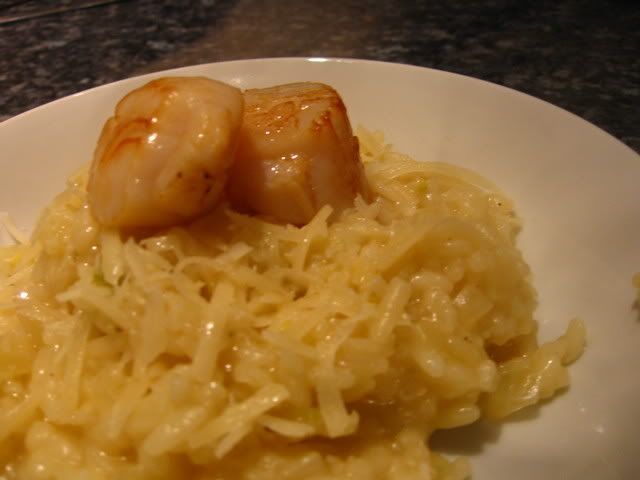
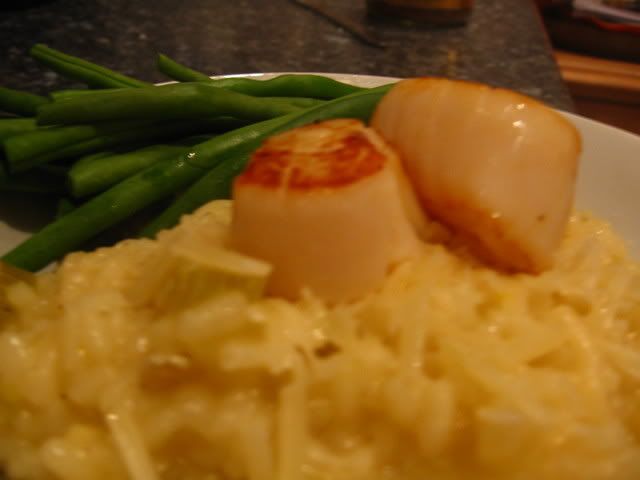
Lemon and Fennel Risotto with Scallops

It's a pity it couldn't be a little more pretty, but sometimes things just aren't so easy on the eye as the palate...

Imagine though, if you will, the creaminess of a risotto, cut through with clean, tangy lemon and studded with soft aniseed-y fennel. You place a little on your fork and add a slice of fried scallop with an almost caramel taste from the seared surfaces, and the inside all meaty and silky.

It's comforting and refreshing and a little bit special and chic all at once.

Make it. See for yourself...

Lemon and Fennel Risotto with Scallops
(serves 4)
  • Fry off a finely diced onion in a generous slug of olive oil over a low heat.
  • Once soft, add one fennel, cut into thin (about 5mm) slices.
  • Add about 400g/14oz arborio rice, and stir until all the rice is coated with oil.
  • Tip in a small glass of dry sherry or white wine and stir in.
  • Then add the juice and zest from two lemons and continue to stir.
  • Cover with a generous amount of vegetable stock, bring to a simmer and put the lid on. Stir every 5 minutes or so for the next 30-40 minutes, making sure the rice doesn't stick to the bottom, and adding more stock or hot water as required by the rice (I never bother with the one spoon at a time method - it's ever so consuming and I'm not sure it makes that much difference - do try not to forget your risotto tho - it will burn!)
  • When the rice is cooked to your taste, stir in a little butter and parmesan for extra creaminess (optional).
  • Heat a little oil in a frying pan til fairly hot, and sear 8 scallops on both sides. Turn heat down and cook for 3 or 4 minutes until cooked through.
  • Serve the risotto with a little parmesan and then the scallops and top, and some green beans on the side.

Tuesday, February 13, 2007

Warm food for cold nights

So, after all the excited newscasters telling us for days there would be the most snow in, like, a Million years, we got, a few days ago, a delicate smattering of the cold stuff; a dusting of squeaky white icing on trees and letterboxes and rooves and cars.


Enough to make me smile at this cute little bike, not enough unfortunately to mean gigantic snow drifts stood impassable in the way of my commute to the office. Enough for kids to create snowball crossfire across the morning streets; not enough to hold out until lunchtime before becoming soot-coloured slush. Enough, though, to make it feel wintery enough to search out the lentils and make this humble but classic dish from my childhood:


Oh I know, there's lentil and sausages a plenty in the cookbooks and gastropubs of the day. But we've been eating this in the saucepan household since I can remember. We've had it on Christmas day, we've had it with friends and without, for celebrations and just for long weekend meals. It's always been a 'treat' food, despite its rustic simplicity, and the unglamourous basis of lentils - how many children have lentils as the basis of their favourite food?...

And although I know there are a myriad variations i could do, I like it just like this. So I'll put the recipe here so you can see if you do too.

Lentils with Chorizo
Serves four

Lentille vertes - check the packet for per person quantities and then add some; it's good cold too if you're not greedy enough to eat it all (Btw - I don't know why similar recipes call for puy lentils - they seem to be much the same, just more expensive. The little lentille vertes do fine for me - not to be mixed up with green lentils, which are bigger, flatter and more mushy)
1-2 onions
1-2 carrots
A few sticks of celery
(Optional - any other bits of vegetable you want to use up such as an old pepper or some cauliflower leaves, etc.)
2 or 3 cloves of garlic
4 or 5 bay leaves
A splash of red wine
A ring of chorizo (or two little ones like you get in Sainsburys)
Stock (or even just hot water, as the chorizo adds lots of flavour)
Salt and pepper

Chop all the veggies into small-ish dice and the chorizo into discs or half-discs, depending on your preference.

Sweat off the onion in some olive oil in a big deep pan, then add carrot, celery and garlic. Cook, stirring, until softened a little.

Add the lentils and stir round til coated in oil and vegetables.

Add splash of wine and stock enough to cover generously.

Add chorizo and bay leaves

Bring to the boil then simmer for about 30-40 minutes until lentils are cooked to taste. Season

Serve with potatoes (to mash in the juice) or crusty white bread. A green veggy or fresh salad will go nicely too.

p.s. apologies for those extremely unphotogenic potatoes. Actually, it's not much of a looker of a dish all round. Trust me though on this one - it tastes good.

Wednesday, September 13, 2006

Oriental-ish Fish


There are some days when, upon returning from another day of existential pondering over what precisely you are doing trapped in front of a computer crunching meaningless data, you just crave some order and satisfying neatness in the kitchen.

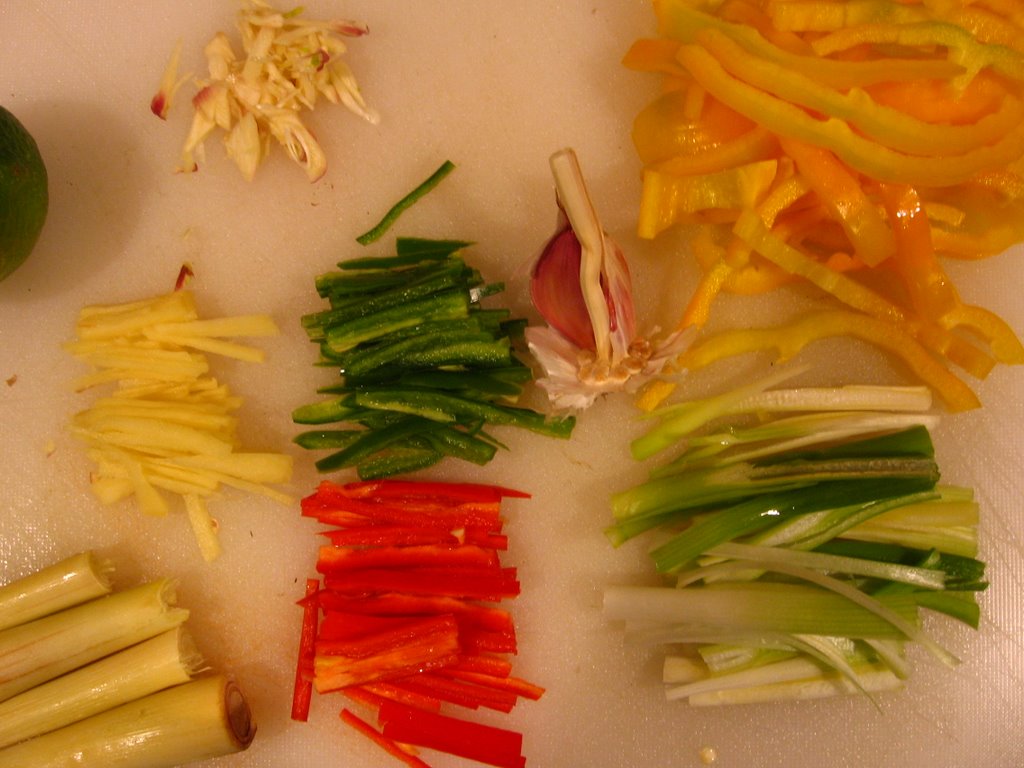
On days such as these, you might feel like chopping things into sharp little sticks, and heaping them in smart little piles, before distributing them in terrifically neat parcels... The order of the veggies on the chopping board will ease the ache of day-to-day tedium in your temples and restore a certain calm to your being.


If such is the case, you might want to consider making a dish such as this. It's nothing fancy; a little bit Supermarket magazine actually - a 'Speedy Supper' kind of thing. But it was exciting for me, as I'd never cooked salmon in a foil parcel before (really? yes, really!). And besides, I was feeling a need for some soothing chopping and ordering of the aforementioned variety. As added benefits, it turned out to be not only pretty easy but also perfectly satisfying and tasty.

I'm calling it Oriental-ish because I make no claim to authenticity - the ginger, chilli, garlic, lemongrass, coconut and coriander are I imagine a westernised impression, a bastardisation if you will, of real Thai food.

But, it was damn good, so I'm happy enough with "ish" fish!

Oriental-ish Fish


for 2 parcels

2 salmon fillets
2 sticks of lemongrass
clove of garlic
knob of ginger
1 or 2 red chillies
1 red or yellow pepper
1 spring onion
1 carrot
(substitute other veg that can be cut into batons if you prefer)
handful of coriander leaves
1/4 block of creamed coconut
1 lime

to serve: thai fragrant rice and pak choi (or green veg of your choice)

* Preheat oven to gas 4-5
* Cut all the veg, the garlic, ginger and chilli into thin strips
* Divide 1/2 of the strips between two large sheets of foil. Bash the lemongrass sticks a little and add one to each sheet
* Skin your fillets, salt and pepper the fish
* Place fillets on top of veg on foil and top with remaining strips
* Pour 500ml boiling water on the creamed coconut block in a little bowl and stir until dissolved.
* Now, fold up the sides of the foil square a little bit so the coconut mix won't escape
* Pour enough coconut in to nearly cover the fillet, then crimp the sides of the parcel together so it is all closed up
* Place on a baking tray and pop in the oven for 20 minutes
* Meanwhile cook your rice and veg - I cook all rice the same and it seems to work - measure the rice out in a cup (approx 50g per person). Add exactly twice the amount of water (in volume - use the cup again). Put a lid on. Bring to the boil. Turn down as low as possible. Now leave for 20 minutes - DO NOT TAKE THE LID OFF until done. It should be sticky and fluffy and perfectly done (however this is a basmati method, so I'm always surprised when it works on other varieties. Don't blame me if it burns - maybe I have always fluked cooking rice!)

* To serve - open the foil parcels and put in all on a plate. Top with a handful of coriander leaves and a good squeeze of lime.